Waterproof, windproof, breathable – these are qualities you often encounter in high-end sports and outdoor apparel. You’ll also see instructions advising that they should only be treated with detergents and waterproofing agents designed specifically for them. But what exactly counts as “designed for them”? If I use something else, like a regular waterproofing spray, won’t it interfere with breathability?
Why does sportswear made with Gore-Tex and Sympatex breathe?
Breathable membrane linings are made from materials with a special structure. Their common feature is that they allow water vapor generated during intense activity to escape from the body – this is their breathable property – while remaining closed from the outside, making them waterproof and windproof. There are several types, with Gore-Tex and Sympatex being the most widespread.
In both cases, the core of the fabric is an extremely thin, membrane-like layer made of Teflon. Teflon has a porous structure – containing billions of tiny holes per square centimeter. These minuscule openings are larger than a water vapor molecule but smaller than a raindrop. Specifically, they are 20,000 times smaller than a raindrop and 700 times larger than a water vapor molecule. This allows moisture to escape outward while preventing raindrops and wind from entering.
We asked Csaba Kutasi, a forensic expert – what is the difference between a water-repellent and a waterproof surface?
Instead of using the foreign-derived term “impregnation,” let’s look at the expressive Hungarian distinctions: water-repellent and waterproof properties.
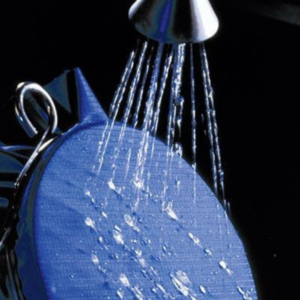
Water-repellent: The outer fabric of sportswear equipped with a breathable layer is water-repellent. In factory finishing treatments that provide this property, the textile is given water-repelling ability without closing its pores, so its air and water vapor permeability is maintained. Thanks to the applied auxiliaries, water landing on the surface does not soak the fabric; droplets roll off.
Waterproof: For garments specifically designed for rain protection, waterproof treatment is applied. This creates a sealing layer on the textile, which prevents water penetration but also eliminates air and water vapor permeability. As a result, water vapor generated by the body cannot escape over large areas, which is why features like mesh openings under the armpits are often added, usually with closable flaps.
Why is it necessary to wash sportswear?
Besides the fact that visible dirt accumulates or that sweat from intense activity causes odor, it is advisable to clean sportswear from time to time. Dirt can also clog the tiny pores of the membrane, reducing—or even temporarily eliminating—its breathable properties.

How should we apply water-repellent treatment?
Water-repellent properties need to be restored or improved during use after cleaning and drying through re-treatment. For this purpose, chemical auxiliaries are available in spray or liquid form. When applied according to instructions, such products do not reduce the breathability of the membrane.
It is essential not to use waterproofing products that clog the membrane’s microscopic permeable pores.
What do we use at DS Fresh?
After washing, we apply the water-repellent treatment in a separate bath. This allows the product to penetrate the entire surface in the proper solution, including the seams. This ensures protection at every point—unlike sprays, where the amount applied is harder to control and hard-to-reach areas may remain untreated.
This method is recommended not only for sportswear but for any outdoor clothing, coats, or hats—after all, who wants to get soaked? Even jackets without a special membrane can be made water-repellent using this procedure.
Do you want to have your sportswear, coat, hat, or other clothing treated?
Bring your garments in person (address: 1089 Budapest, Bíró Lajos u. 64.) and request water-repellent treatment, or order online with home delivery in Budapest CLICK HERE.

Csaba Kutasi – textile chemist, industrial engineer, forensic expert, and specialist author
- He worked for decades in the domestic textile industry in leadership and quality management positions.
- As an instructor and author of study materials, he has made significant contributions and is a dedicated supporter of training the next generation of professionals.
- He has been an active member of the Textile Technical and Scientific Association since 1969, and his work has been recognized with several professional awards, including the MTESZ Commemorative Medal.
Why should I use special detergents for technical clothing?
Because regular detergents can clog the membrane’s pores or damage the water-repellent layer. Special detergents clean gently while preserving breathability and water repellency.
Doesn’t reproofing (impregnation) reduce breathability?
No, if you use the right product. A proper reproofing agent makes the outer layer water-repellent without blocking the pores, so the fabric can still “breathe.”
What happens if I use the wrong detergent or reproofing product?
The garment may lose performance: water repellency can decrease, breathability can be reduced, and the material may wear out faster.
How often should I reproof technical clothing?
It depends on use, but generally after several washes. If water no longer beads on the surface and starts soaking in, it’s time to reproof.