There are several methods for cleaning clothes, each based on different processes and technologies. In this blog post, we’ll compare dry cleaning, wet cleaning, and home laundry.
We’ll explain each option in detail to help you choose the best one.
1. Dry Cleaning
Method and Technology:
Dry cleaning takes place in a tumble drum machine, where the clothes go in and come out dry (hence the English term “dry cleaning”).
Like a washer-dryer, the drum rotates the clothes. The key difference is that dry cleaning uses a organic solvent instead of water. In this solvent—such as perchloroethylene—stains and dirt are removed. Perchloroethylene is a highly toxic, corrosive, and carcinogenic substance that is hazardous to health, potentially causing breathing difficulties, headaches, nervous system damage, and memory loss.
This is why it is crucial that no residue remains in the clothing. Simply spinning is not enough; the remaining solvent must be evaporated. After each cleaning cycle, the garment is dried and the solvent is distilled, leaving the clothes completely dry.
As with all professional cleaning, pre-treatment of stains before machine cleaning and professional finishing afterward (machine or hand ironing) are essential to ensure optimal results.
Advantages:
- Effective cleaning: Dry cleaning is especially suitable for delicate fabrics such as silk, wool, or cashmere, as it does not saturate the material with water, preventing deformation of the fibers.
- Targeted stain removal: It efficiently removes oily and greasy stains.
- Expertise: Operating a dry cleaning machine requires professional training—every company needs skilled personnel, which makes the service more reliable.
- Successful stain treatment: With expertise, special stain removers and treatment tables are used to loosen and treat stains. However, this is not magic; deeply set, long-standing, or repeatedly treated stains cannot be removed instantly.
Disadvantages:
- Environmental impact: The solvents used are neither eco-friendly nor skin-friendly, and their waste requires specialized disposal. In many countries—west, east, north, and south—perchloroethylene is already banned, and such dry cleaning machines cannot operate in residential areas. In Hungary, updated regulations are still pending.
- Cost: Dry cleaning is generally more expensive than home laundry and can be more time-consuming because it requires professional services.
- Damage to fabrics: Dry-cleaned clothes may fade or yellow, and decorations that aren’t solvent-resistant (e.g., sequins, beads, buttons) can be removed.
- Partial stain removal: Water-soluble stains are not removed and must be treated before dry cleaning.
- Does not remove odors: Sweat or food smells often remain, and the clothes can even acquire a strong chemical odor. Garments cleaned this way should not be worn immediately; they are recommended to air out for at least 4–5 days.
2.Wet Cleaning (AquaTouch Technology)
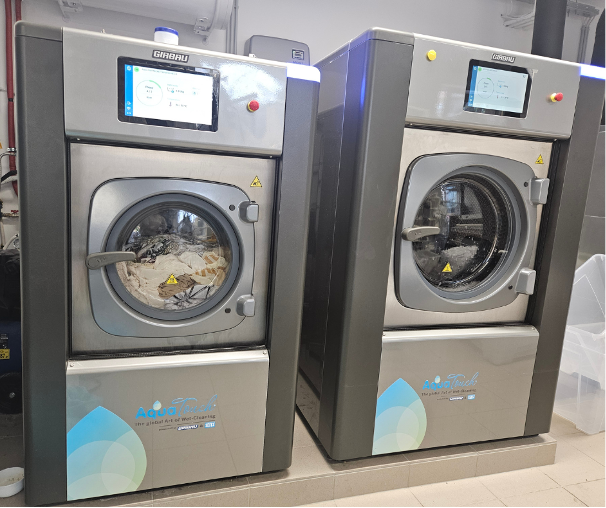
Method and Technology:
Wet cleaning is a specialized form of “dry cleaning” that uses water instead of organic solvents. The machine is filled with water, and during the cleaning process, the mechanical action, temperature, and duration are significantly lower than in regular washing. Its symbol in the care label sequence is a circle with a W (dry cleaning uses P or F, and A indicates any solvent).
Professional cleaning—regardless of the solvent—starts with stain treatment and ends with finishing (machine or hand ironing). Pre-treatment of stains is particularly important in wet cleaning because the machine’s mechanical action is minimal.
The name comes from the fact that the garment comes out wet, and finishing is also done while still damp. In wet cleaning, the final size, shape, and smoothness of garments are achieved on upper garment and trouser ironing forms.
Because mechanical action is minimal, the process uses very low water levels and short cycles, placing emphasis on the chemical cleaning effect. AquaTouch technology employs special, biodegradable cleaning agents.
Adventages:
Advantages of Wet Cleaning (AquaTouch Technology):
- Safe for delicate fabrics: When done correctly, wet cleaning is gentle and does not damage the material or embellishments, making it ideal for sequined, beaded, or heavily decorated garments.
- Environmentally friendly: The cleaning agents used are generally less harmful to the environment than dry-cleaning solvents. For example, the AquaTouch system uses phosphate-free detergents, which are more eco-friendly than most household detergents. Compared to home washing, professional wet cleaning uses 58% less water, 17.5% less energy and chemicals, and produces lower CO₂ emissions.
- Most innovative solution: The machines represent the latest in AquaTouch technology. Technical details are available on request.
- Residue-free cleaning: Clothes do not retain harsh chemical odors that could evaporate and pollute indoor air or irritate the skin.
- Pleasant fragrance: Cleaning with water and the appropriate scent additives leaves garments fresh-smelling. AquaTouch also offers fragrance-free programs to accommodate personal preferences.
- Gentle cleaning process: Computer-controlled washing and drying machines with automatic detergent dosing are gentler on garments than dry cleaning or even home washing.
- Shorter cleaning time: Thanks to the machine’s specifications and size, garments can be cleaned faster than at home—typically about 1 hour per load.
- Safe for children’s clothing: Due to chemical vapors, dry cleaning is not suitable for children’s clothes, but wet cleaning makes even garments labeled “dry clean only” safely washable in water.
- Targeted cleaning: Effectively removes water-soluble stains.
- Expertise: Operating professional cleaning machines requires trained staff, ensuring reliable service.
- Effective stain treatment: Skilled operators use special stain removers and treatment tables to loosen and treat stains. While highly effective, deeply set or long-standing stains may still be difficult to remove completely.
Disadvantages:
- Effectiveness: Removing oily stains is more challenging than with dry cleaning, but wet cleaning is still more effective than home washing. Proper pre-treatment of stains before the cleaning cycle can significantly improve results.
- Higher expertise required for finishing: Fabrics behave differently in water than in solvents—certain fibers, like wool, absorb more water. This doesn’t mean they can’t be wet-cleaned, but finishing (ironing or shaping) takes longer. Home washing machines already have wool programs for this reason.
- Less familiar technology: Manufacturers often do not test their garments for all cleaning methods, so care labels may not reflect actual cleanability. In such cases, responsibility typically falls on the consumer, and few cleaning services can provide fully competent guidance.
3. Home Laundry
Method and Technology:
- Home laundry involves the use of household washing machines or hand-washing techniques.
- The process typically uses water, detergent, and sometimes fabric softener, with different washing programs depending on the fabric type.
- Unlike professional cleaning, which starts with stain treatment and ends with finishing (ironing), home laundry begins when the clothes are placed in the machine and ends when they are removed.
Advantages:
- Cost-effective: Generally cheaper since no specialized services are needed.
- Convenient and flexible: Can be done anytime as part of daily routine without special preparation.
- Reduced environmental impact: Using proper settings and eco-friendly detergents can lower environmental effects, although achieving the same cleaning efficiency as professional methods may be challenging.
- Discreet: Laundry stays within the household—no need to expose your personal laundry to others.
- Part of household management: Often managed by one household member. While it can feel like a responsibility, it allows control over results. Many people also enjoy the fresh scent of drying clothes, and ironing can be a meditative task.
- Most clothing does not require professional treatment: Modern casual garments, especially cotton-based, are generally suitable for home washing, unlike older wool or tailored clothing that often required professional care.
Disadvantages:
- Special care for some fabrics: Delicate materials like silk or wool can be damaged if the wrong program or detergent is used.
- Washing machine limitations: Household machines may not clean as deeply as professional services, especially for stubborn stains. Large textiles (e.g., mattress covers, big blankets) often don’t fit.
- Program restrictions: Domestic machines usually offer limited control over mechanical action, water level, and temperature compared to industrial setups that can use multiple water inlets and precise washing phases.
- Time investment: Washing isn’t automatic; it consumes your valuable time and energy, even if you multitask.
- Total process time exceeds machine cycle: Home laundry involves collecting, sorting, treating stains, washing, drying, ironing, and folding—much more than just running a washing machine. Mistakes can lead to redoing or even discarding clothes.
- Cannot wash all laundry together: Sorting by fabric type and color according to care labels is necessary to avoid damage or color transfer. Underloading wastes water; overloading risks poor cleaning.
- Space requirements: Washing machines are usually tucked away, but drying and ironing require significant space. Small apartments make this challenging, as drying racks, ironing boards, and laundry baskets occupy living areas.
- Lack of professional expertise: Most people learn laundry skills informally, but professional cleaning is a specialized field requiring training and expensive equipment. Mistakes can be costly, and professional support is sometimes only sought after a problem arises.
Which is the best?
Everyone should decide this for themselves! The cleaning method you choose depends on how much time you have to solve the problem and what tools are available. It also depends on the types of fabrics and stains you need to treat, as well as other priorities important to you—such as personal or children’s health, gentle treatment for textile longevity, sustainability and eco-friendliness, urgency, or efficiency.
Or perhaps one of the most important questions: do you want to do it yourself, or will someone else do it for you (e.g., your spouse, housekeeper, mother, etc.)?
Dry cleaning: Ideal for delicate, sensitive fabrics, but comes with significant health, environmental, financial, and ethical considerations.
Wet cleaning: The most modern, eco-friendly technology, which is gentle, fast, and effective. It is suitable for any item you would normally take to a dry cleaner. The downside is that manufacturers are less familiar with it, so clothing labels may be less reliable.
Home washing: An accessible and convenient solution for everyday use (if you’re the one doing it), but it may not provide the best cleanliness or gentleness for all fabrics. Without proper expertise, you can cause serious damage to textiles and shorten their lifespan.
Choosing the right cleaning method depends on the fabric type, desired quality, and environmental considerations. It’s worth weighing the pros and cons to select the best solution for each situation.
Technological Comparison

What can be treated?

Which option do you support with your choice?
After comparing the above methods and technologies, along with their advantages and disadvantages, you can responsibly decide which solution is best for you.
Have you decided to try our service? See how easy laundry can be with us!
How does it work?
Do you want to manage your time yourself? Here are our services:
What is the main difference between dry cleaning and wet cleaning?
Dry cleaning uses solvents, while wet cleaning uses water and special gentle detergents.
Which method is more eco-friendly?
Wet cleaning is generally more environmentally friendly because it does not use harsh solvents.
When is home washing not enough?
For delicate fabrics, stubborn stains, large textiles, or garments that need professional shaping, it’s best to turn to experts.
Why try AquaTouch wet cleaning?
Because it provides gentle, fresh-smelling, residue-free cleaning while protecting both your clothes and the environment.