Shrunk in the wash – did you know this isn’t necessarily the fault of the washing process?
When exposed to water, the fibers that make up the fabric—especially natural ones—swell and shrink; it’s simple physics. We’ve all noticed that jeans stretch out with wear but feel tight after washing. Sweaters elongate, pants bag at the knees, and then after washing, they often return to their original shape.
How long is size variation considered normal?
Before diving deeper into fiber knowledge, it’s important to note that this is a normal process.
Did you know that manufacturers can label a product as “size-retentive” if its dimensional change stays within 3%?
During production, many steps—from fiber quality to finishing processes—affect a garment’s size stability. It’s also common knowledge among seamstresses that fabric needs to be “conditioned” before cutting, meaning it should be washed. The first wash removes residual chemicals from production and allows the fabric to settle into the dimensions it will maintain during wear.
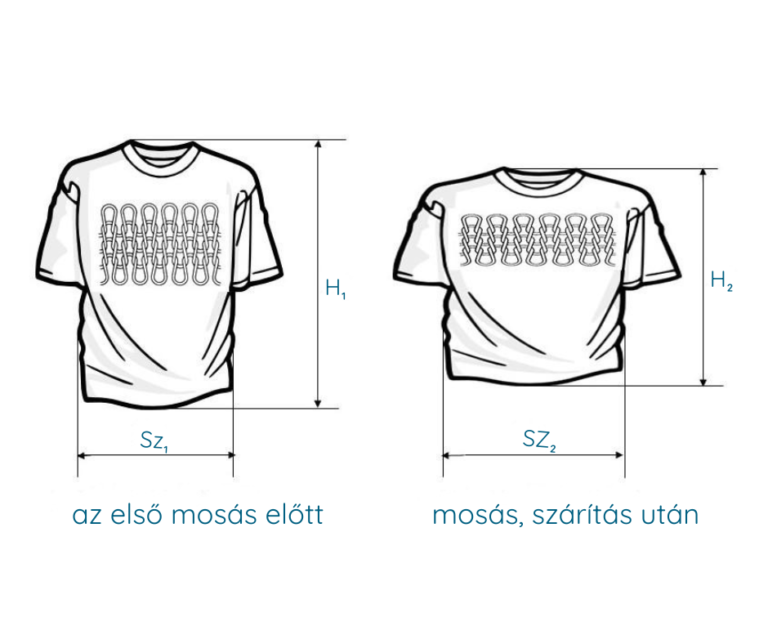
During wear, the fibers stretch, twist, and the fabric distorts and shortens due to body heat, moisture, and movement. After washing, the fibers return to their original shape, which is why clothes often feel smaller after washing. Moreover, if a garment is worn for a long time and the wearer gains a few kilograms, the fabric stretches with the body; after washing, it may not fit at all.
Because these size changes are entirely natural, no cleaner can take responsibility. Washing simply restores the garment to its original state—with all the advantages and limitations that entails.
Do all garments shrink the same way?
Of course, some fabrics swell more in water and therefore shrink more—what we commonly call “noticeably shrinking.” A typical example is wool. Wool absorbs moisture very well (which is why it’s also a good insulator), and even when fully saturated, it remains elastic and stretchable.
Modern washing machines often have a wool program—despite common belief, fabrics made from processed wool fibers are washable. The trick is to correct any size changes while the garment is still wet: reshape it to the proper dimensions and then dry it. If we’re resizing a loved one’s wool sweater for a child, there’s a good chance we’ll do it in the dryer.
Textile manufacturing and textile care are true professions. Are you interested in their mysteries?
Let’s dive into fiber knowledge:
The shrinkage of textile products in water is influenced by several factors.
- Fiber swelling capacity: The ability of the fibers that make up the fabric to swell is a key factor. Fibers with high water absorption—such as cotton or viscose—swell significantly, increasing their volume and cross-section, which alters the structure of the yarns.
- Cellulose derivatives and synthetic fibers: Fibers like cellulose acetates and synthetics (polyester, polyamide, polyacrylonitrile, etc.) absorb less water, swell less, and therefore experience much smaller shrinkage.
- Effect of fiber swelling on yarn structure: As fibers swell, the thicker yarns force the fibers to reposition on a larger cylindrical surface, creating contraction forces that shorten the yarn. At the same time, the paths around fabric interlacing points (crossings) lengthen and shift closer together, causing the fabric to shrink.
- Weave structure: Yarn density (the number of yarns per 10 cm) also affects shrinkage. Fabrics with higher yarn density and closely spaced interlacing points shrink less.
- Residual stresses from production: Tensions accumulated in yarns during spinning and winding, and in fabrics during finishing (longitudinal stress during finishing and drying conditions), also affect shrinkage. When wet fibers swell, these stresses are released, resulting in shrinkage.
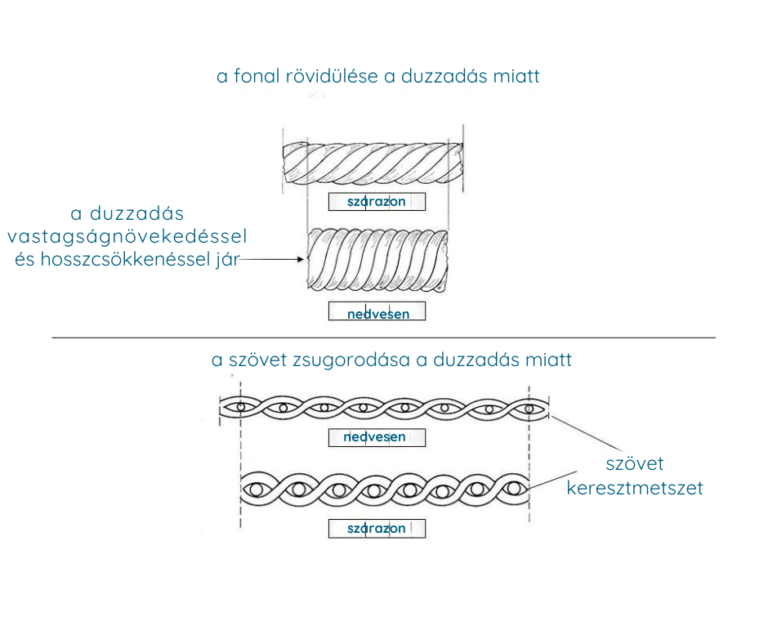
This is why non–size-stable products shrink: What do manufacturers do to prevent shrinkage? We asked Csaba Kutasi, forensic expert:
For fabrics made of cotton or viscose, factory shrinkage reduction can be achieved through mechanical shrinkage control (sanforization) and resin finishing. In sanforization, the fabric’s yarns are forced into the position they would naturally take after several washes. In the chemical finishing process, resin introduced into the fiber creates, for example, cross-links within the internal structure, reducing swelling and shrinkage. For synthetic fabrics or blends with a higher synthetic content, heat-setting significantly limits shrinkage.
For knitted fabrics, dimensional stability is generally achieved mechanically on specialized shrinkage-controlling machines called compactors.

Csaba Kutasi – textile chemist, industrial engineer, forensic expert, and specialist author
- He worked for decades in the Hungarian textile industry in leadership and quality management positions.
- As an instructor and author of study materials, he has made significant contributions and is a dedicated supporter of training the next generation of professionals.
- He has been an active member of the Textile Technical and Scientific Association since 1969, and his work has been recognized with several professional awards, including the MTESZ Commemorative Medal.
Why do clothes shrink after washing?
Natural fibers swell when exposed to water, causing the fabric structure to contract. This is a natural physical process.
What level of shrinkage is considered normal?
A size change within about 3% is generally acceptable and considered normal by manufacturers.
Do all fabrics shrink the same way?
No. Cotton and wool tend to shrink more, while synthetic materials (like polyester) shrink less.
Can shrinkage be prevented?
Partly yes: follow care instructions, avoid high temperatures, and reshape delicate items while drying.